F2A "Buffalo", Brewster Fighter
Developer: Brewster
Country: USA
First flight: 193
Type: Carrier-based fighter aircraft
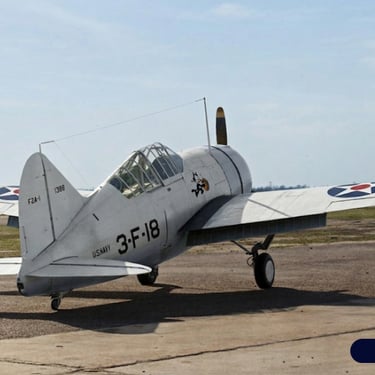
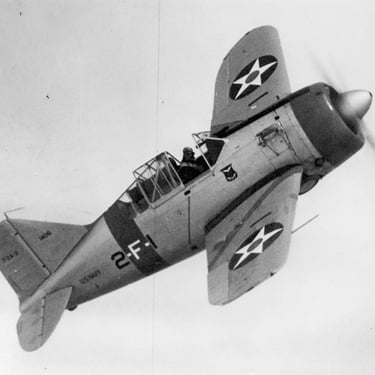
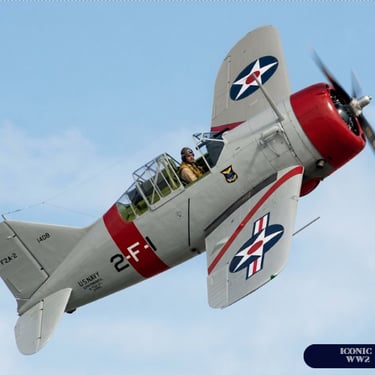
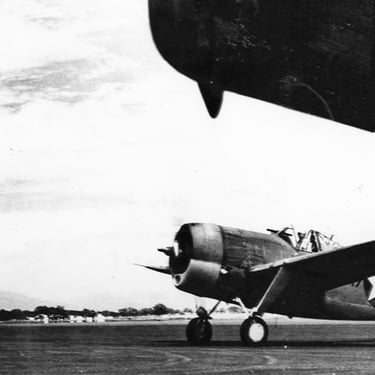
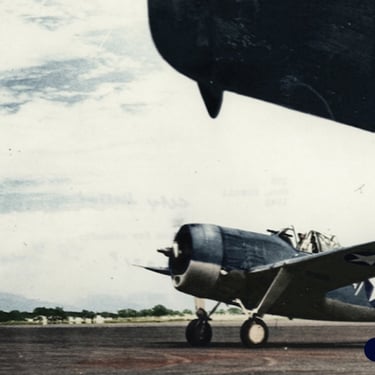
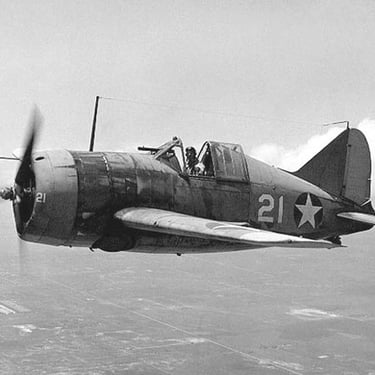
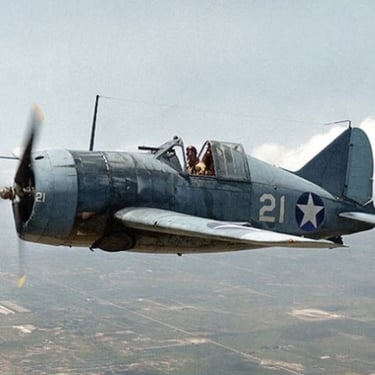
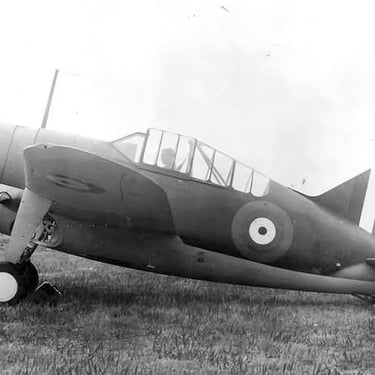
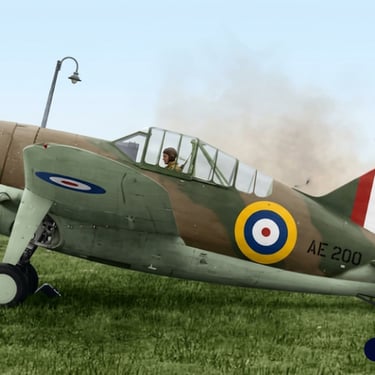
In the mid-1930s, the United States was in a deep depression. The great nation's budget was in tatters, with barely enough money for anything. The defense industry was no exception. The army was poorly armed, and the navy was receiving new ships created through a strange compromise—maximum technical specifications were required at minimum cost. Needless to say, such a compromise could render a combat unit unsuitable for use in a real war. The US air force also presented a rather unsightly spectacle. Alongside highly advanced designs, such as the Boeing B-15 and B-17 bombers, which were built in limited numbers, the fleet included aircraft whose lifespan had already been measured. The Curtiss and Boeing biplane fighters used by the army and navy had only one advantage—maneuverability—but numerous shortcomings: low power-to-weight ratio, low speed, short range, rate of climb, and survivability. Their standard armament was two Colt-Browning infantry-caliber machine guns with 150-200 rounds of ammunition. With such a weapon, it was only possible to shoot down a World War I-era aircraft, and even then, only with a successful hit.
The only exceptions to this rule were the Boeing P-26 Peashooter monoplane fighter and the Grumman F2F/F3F. The former, a military aircraft, combined progressive features such as all-metal construction and a semi-monocoque fuselage with anachronisms such as a steel-braced wing, a fixed, faired landing gear, and an open cockpit. The latter, designed for use from aircraft carriers, also had an all-metal, progressive design, a semi-monocoque fuselage, an enclosed cockpit, and retractable landing gear. Its armament consisted of one conventional and one heavy machine gun, increasing the weight of a second salvo. But the aircraft was also a braced biplane, and, moreover, overweight for its relatively weak engine, producing only 700 horsepower. This resulted in a low speed and rate of climb. And this was at a time when all the world's aircraft designers were already busy designing high-speed fighters - monoplanes.
Another problem facing American aviation was the inability to produce aircraft in large quantities due to the same notorious lack of funds. This reached the point of absurdity: in some cases, the US Army, when ordering a new aircraft from a company, not only failed to pay for R&D and prototype construction, but even the engine for the new plane was leased, not fully utilized. Under these circumstances, the US Navy, whose leadership recognized the need for new, modern aircraft for its carriers, announced a competition for a high-speed carrier-based monoplane fighter. This took place in early 1935. There were two winners: Brewster and Grumman. Grumman's designers took a very practical approach to the design of the new aircraft—their design was nothing more than a redesigned F3F biplane. However, preference was given to the Brewster design. This company was very old and well-known in the United States. It initially produced stagecoaches and other horse-drawn vehicles, and then, in the 1970s, with the onset of the railroad boom, switched to mass production of railroad cars. The headquarters of the company's specially created subsidiary, Brewster Aeronautical Company, was located on Long Island, near New York City.
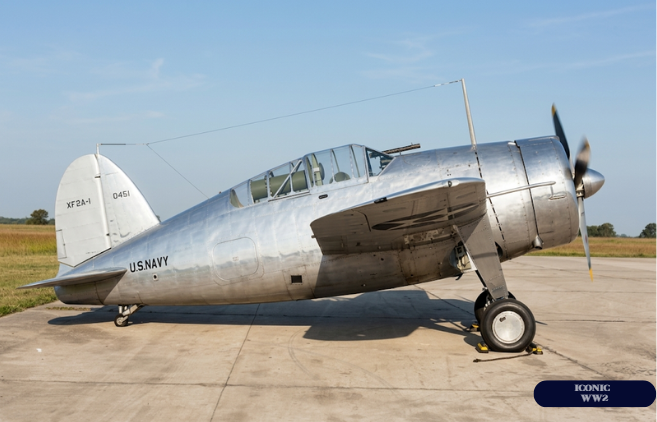
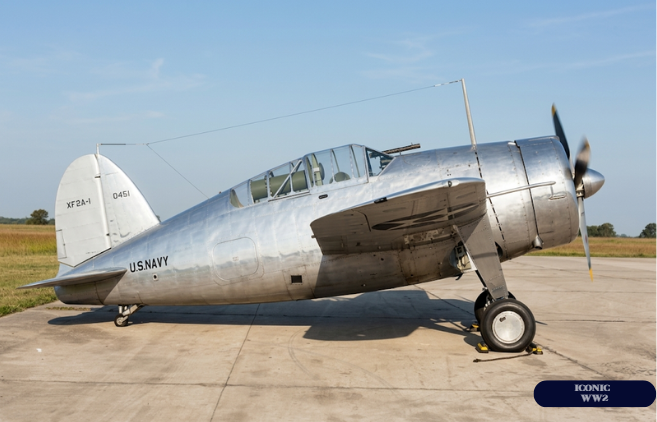
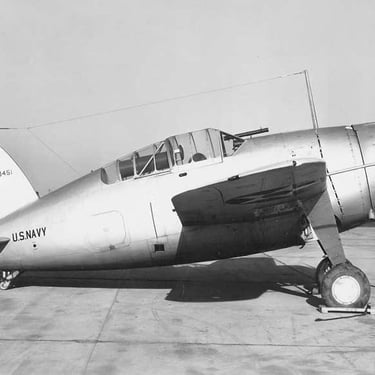
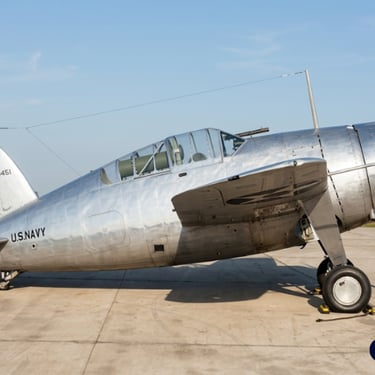
Why did the Navy choose a design developed by a railroad car company rather than by professional aircraft designers? The answer is clear: purely for economic reasons. Brewster's design turned out to be somewhat cheaper and simpler than Grumman's. Legend has it that the fuselage assembly technology for Brewster's fighter was based on that of a railroad tank car. Thus, the Navy's order for a prototype of a new fighter, designated XF2A-1, was received by Brewster in late 1935. In June 1936, production of the prototype began, and a year and a half later, it began flight testing. During these tests, it was discovered that even in a lightweight configuration, without wing tanks and machine guns, and with polished skin, the aircraft could not reach the contract speed of 444 km/h. The customers stated that if these parameters were not met or exceeded, the contract would be terminated. For Brewster, the order for the F2A was a matter of survival. Therefore, the prototype was rushed to Langley Field and tested in the NACA wind tunnel. This was the first time in the United States that a full-scale aircraft was tested in a wind tunnel.
Following the test runs, several changes were made to the aircraft's design, improving its aerodynamics. Specifically, the engine cowling was refined, seam sealing was improved, and some convex rivets were replaced with countersunk ones. Following these modifications, the aircraft reached a speed of 487 km/h (300 mph), more than satisfying the customer. On June 11, 1938, Brewster received an order for 55 aircraft with the serial designation F2A-1. Thanks to the aircraft's advanced technology, the order was completed by mid-autumn. Eleven aircraft entered service with the naval squadron VF-3 "Felix the Cat," and the remainder were purchased by Finland. In some respects, particularly range and armament, the first series aircraft no longer fully met U.S. Navy requirements, and the Finns, whose air force was on starvation rations, were pleased with the relatively simple and inexpensive aircraft. Aircraft shipped for export were adapted for use from land-based airfields: the landing hook and the rescue dinghy located behind the headrest were removed. The lower cockpit glazing, which had proven practically useless, was covered with an aluminum panel. The cast rubber tail roller was replaced with a puffer wheel. The engine was replaced with a more powerful one (950 hp). The aircraft thus converted received the "export" designation B-239. The Finns carried out their own modifications on the Brewsters they received, but more on that below. Aircraft delivered disassembled from the USA were assembled at SAAB factories in Sweden. Valmet also attempted to establish production of native Finnish Brewsters, which differed from the prototype in having a wooden wing. One aircraft, named "Humu," was built. It has been preserved to this day in one of Finland's aviation museums, and according to the author's information, it is the only surviving Buffalo.
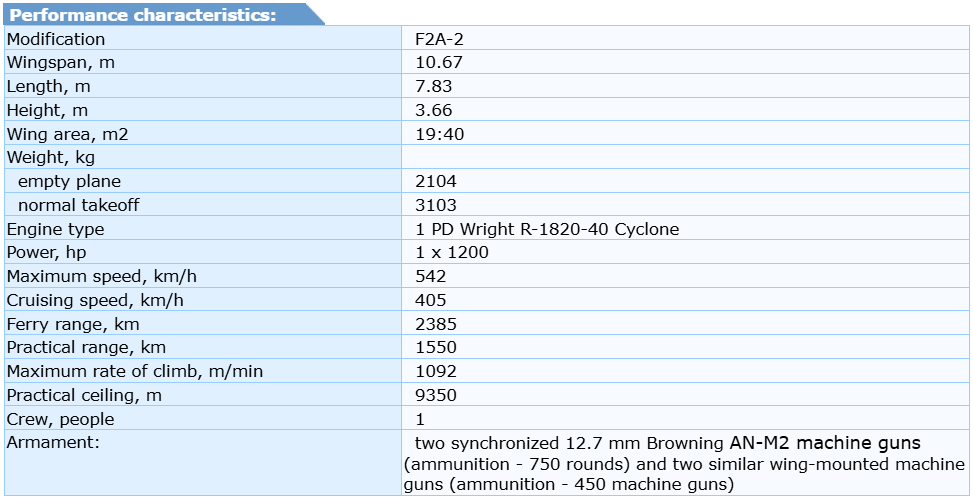
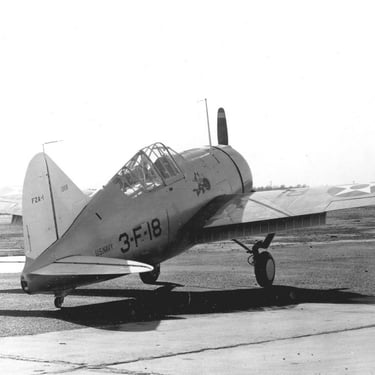
The next model had the US Navy designation F2A-2 and the export designation B-339. The main difference of this aircraft was the Wright R-1820-G40 engine producing 1,200 hp with a more efficient Curtiss Electric propeller. Its prototype made its maiden flight in June 1939. The US Navy received 43 aircraft, which were assigned to squadrons VF-2 and VF-3, as well as to the reconnaissance squadron VS-201. The first foreign customer was Belgium, which ordered 40 aircraft, but almost the entire batch, with the exception of two aircraft, was diverted to England after the capitulation of Belgium. The Allies were initially very interested in the aircraft, which received the name "Buffalo" Mk.1 in England. The Brewster company received a large order for 170 aircraft of a slightly modified configuration (B-339E). They differed from the B-339 in the engine series (while maintaining the same power) and the Hamilton Standard propeller with a diameter of 3.12 meters. These aircraft were equipped with an ST-1 collimator sight. The landing hook was eliminated, and the tail spinner's shape was changed. The lower glazing was eliminated. Starting with this series, the aircraft received a more robust landing gear, which, however, proved to be insufficiently robust.
In 1940, the Dutch West Indies ordered 72 aircraft, designated B-339D. They differed from the previous series in having somewhat simplified avionics, a non-retractable tailwheel with a cast rubber roller, and, again, a telescopic sight instead of a collimator. The final model of Brewster's fighter was the F2A-3, also known as the B-439. This aircraft had a main fuel tank increased to 255 liters, which required lengthening the fuselage by 309 mm. The aircraft's engine, a Wright GR-1820-G205, had a nominal output of 1,230 hp, but could be boosted to 1,420 hp for short periods. The lower glazing was not provided; the glazing of the sliding part of the cockpit canopy was modified, reducing the number of sashes. On late-production aircraft, the tall radio mast in the forward fuselage was abandoned; the antenna was now stretched in two strings between the tip of the vertical stabilizer and the rear fuselage. The aircraft was produced from January to November 1941; 107 were delivered to the US Navy and Marine Corps, and an additional 20 B-439s were exported to the Dutch West Indies Air Force.
In the United States, the Buffalos, initially based on the carriers Lexington and Saratoga, were replaced by more modern Wildcats in March-May 1941. They were transferred to shore bases as trainers. Some aircraft served in this capacity until the end of the war. Several F2A-2 aircraft were part of the Panama Canal air defense group until 1945. A small number of aircraft of the same type (less than 10) from VS-201 served on the escort carriers Long Island and later Card in late 1941-1942. Their primary mission was to search for German submarines, first in the North Atlantic and then in the Caribbean. The Buffalos of this squadron were credited with detecting eight submarines and damaging one. F2A-3s served with Marine Corps Squadron VMF-221 until 1942. This squadron was initially based at Pearl Harbor and then deployed to Midway Atoll as reinforcements. During the Battle of Midway, the Japanese shot down 13 Buffalos and destroyed another six on the ground. Buffalo pilots were credited with downing three bombers and two fighters in this battle. This disastrous loss ratio can be attributed to two factors: the obsolescence of the Buffalo and the extremely low level of training of Marine Corps pilots in 1942. Furthermore, the Japanese enjoyed complete and undisputed air superiority at this time. Finnish and British Imperial pilots used the Buffalo most intensively and successfully in combat.
The Finns received a total of 44 B-239 aircraft. These aircraft underwent significant modifications. While the aircraft initially carried a standard armament of one 7.62mm and one 12.7mm synchronized Browning, plus two wing-mounted 12.7mm machine guns, starting in 1943, the surviving Brewsters received four 12.7mm LKK/42 machine guns—essentially the same Finnish-made Browning AN-M2, but significantly redesigned—with a rate of fire of up to 1,100 rounds per minute. The aircraft received Finnish Väisälä Thm40 reflector sights. An ARK with a ring antenna was installed behind the armored backrest in place of the rescue "inflatable." Six aircraft managed to take part in the "Winter War" with the USSR in 1940. It was then that the combat account of the Finnish "Buffalos" began. The Red Army Air Forces were primarily armed with aging I-15, I-15bis, and I-153 biplanes, which the Buffalo was relatively easy to counter with hit-and-run tactics. High structural survivability and decent armor protected the aircraft and pilots from the fire of the 762mm DA and ShKAS machine guns. The Red Army's own onboard armament—large-caliber, rapid-fire machine guns, distinguished by excellent ballistics and accuracy, with a huge ammunition complement—was optimized for combat against fighters. With the advent of the I-16 monoplane on the Soviet-Finnish front, the situation remained virtually unchanged: the early and even mid-production I-16s were 15-20 km/h slower than the Buffalo, yet offered comparable horizontal maneuverability. The success of the Buffalo aircraft during the "winter campaign" is evidenced by the fact that six Brewster fighters scored 17 confirmed victories and another two and a half dozen unconfirmed ones, without the loss of a single Buffalo. A significant factor in this success was the superior experience and tactics of the Finnish pilots over their Soviet counterparts—mostly recent cadets from flying clubs focused on mass-producing inexperienced personnel. The Finns, who acquired aircraft "from hand to mouth," honed their mastery of the aircraft to perfection, being both excellent pilots and tacticians. Such Finnish aces as E. Juutiläinen (92 victories), H. Wind (78 victories), and E. Luukanen (51 victories) flew the Buffalo. Incidentally, Finn Hans Wind was the absolute world record holder for victories achieved in the Buffalo aircraft - 39 confirmed and 5 unconfirmed.
True, the Buffalo had its shortcomings—a delicate engine that wouldn't start in -20°C weather, and a weak landing gear with high-pressure tires that often broke during rough landings. But during service, the aircraft's virtually unlimited repairability became apparent. Finnish Buffalos flew until the end of World War II. By the time Finland defected to the USSR in 1944, they were already patched-up oldsters with peeling paint, numerous dents, and "finished" parts from exhaust and carbon deposits. Many aircraft had captured Soviet M-25, M-62, or M-63 engines instead of their original ones. And even in this state, these honored veterans, whose place should have been in a museum or an aircraft scrapyard, flew combat missions. The last victim of the Buffalo—by then already capitulating—was a recent ally, a Junkers-88 reconnaissance aircraft, which, for some unknown reason, had ended up over the Murmansk-Leningrad railway. This happened in January 1945.
The Buffalo Mk.1 aircraft supplied to Great Britain were initially used in the islands' air defense role, but when it became clear that the Cyclone, lacking a supercharger, began to choke at altitudes as low as 4-5 km, the aircraft were quickly transferred to Crete. There, for a short time in the spring of 1941, the Buffalos attempted to intimidate the Germans by patrolling the island's airspace. The Germans, flying Bf.109Es, were unwilling to be intimidated, and the British understood that the low-altitude, slow-moving Buffalos had no place in air defense. The Cretan Buffalos, along with those stored in the homeland, were transferred to Great Britain's Far Eastern dominions—Burma, Malaya, and Singapore. There, they came under the command of two British, three Australian, and one New Zealand Royal Air Force squadrons. On December 7, 1941, they actively joined the fighting.
A few words should be said about the staffing principles of the British Air Forces stationed in the Dominions. The majority of the pilots were young, "green," and overconfident, who had been led to believe that their potential adversary—Japan—had an air force equipped with ancient aircraft made of wood and percale, armed with what amounted to stone throwers. This was the result of skillful disinformation carried out by Japanese counterintelligence. Here's a classic example of such disinformation: at the initial stage of the war, until mid-January 1942, the British were convinced that the new Mitsubishi Type 0 naval fighter had fixed landing gear and was armed with two infantry-caliber machine guns. The fact is that, even during the conflict at Lake Khasan, the Japanese engineered a leak, and British intelligence obtained a poorly executed photo of the Nakajima Ki-27 ("Nate") aircraft, captioned "New Fleet Air Force Type 0 Fighter." Interestingly, this photo and caption appeared in some Soviet sources in the 1970s.
Incidentally, that same Ki-27 was the most common aircraft in the Japanese Air Force's Far East region, as mass production of the Zero and Hayabusa was just getting underway. By December 7, 1941, the first-generation Nakajima Ki-43 Hayabusa was in service with only two of the five Japanese Air Force fighter sentai (regiments) stationed in the Far East. However, the small number of new fighters was more than compensated for by the quality of training and combat experience of Japanese pilots; most of them already had several hundred flight hours under their belts and experience in conflicts at Khalkhin Gol, Khasan, and in China. True, the British also staffed their air force with approximately a quarter of personnel who had combat experience from the Battle of Britain. But what kind of personnel were these? Mostly experienced pilots had suffered serious injuries in the past or had been discharged for other reasons, such as age. Thus, pilot of the 488th Squadron of the New Zealand Air Force, Jerry Fisken, who flew the Buffalo and shot down 7 Japanese aircraft in this type of fighter, had a punctured lung by the beginning of the war in Asia, because of which he could not fly at altitudes above 3-4 km without oxygen equipment (and the Buffalo, by the way, did not have this equipment).
Based on the above, one can conclude that the balance of power in the Far East was clearly not in favor of the Brewster product. Indeed, during the fleeting campaign that ended with the fall of Singapore and the Japanese seizure of Malaya, 158 RAF Buffalos were lost in the air and on the ground, while they shot down just over 40 Japanese aircraft. But it should also be noted that three Allied pilots became aces flying the Buffalo: J. Fisken, P. Mulvaney (7 victories), and K. Greeney (5 victories). Fisken was never shot down in a Buffalo, Mulvaney was shot down once and had to make a forced landing in the jungle, and Greeney was shot down only once on takeoff. Paddington Mulvaney recalled how he was shot down: "At five in the morning we were raised on alert - spotters reported that ten "Bettys" were approaching our airfield ... When I ran to my plane, bombs were already exploding around ... Having taken off from the ground and gained 250 feet in altitude, I looked around - besides me, only one plane managed to get into the air - it was my squadron commander. He was coming on the tail of the bomber, without even retracting the landing gear ... Two escort fighters followed me. They were shooting at me with four barrels ... I tried to break away from the Japs in a dive - usually this trick worked for me. But at that moment several bullets hit my "Buffalo" at once. The engine smoked heavily and began to reduce speed ... Losing altitude foot by foot, I tried to get away from the enemy by sliding. Below I saw the bed of a small river. This, in the end, and "saved... I descended to the tops of the palm trees and, looping, flew over the water... There was already one Japanese behind me - suddenly my plane skimmed the water with its belly and crashed into the wall of the jungle. I cowered behind the dashboard. Two or three crushing blows followed, the cracking of palm trunks. The canopy was cut off completely... The plane finally stopped. Not believing that I was still alive, I climbed out. I had only a few bruises and scratches. The plane was smoking heavily, but even after such a terrible landing, its wings did not break off..."
As we can see, in most cases, success or failure in aerial combat depends primarily on the skill and initiative of the pilot. Of course, an aircraft designed in the mid-1930s cannot be considered the pinnacle of perfection even at the outbreak of World War II. But in the hands of experienced pilots, even it was capable of great things. In the case of the Buffalo, this was confirmed by both the Finns and the British: the same aircraft was considered one of the best in the Finnish Air Force and one of the worst in the American Air Force. But despite all the ambiguity surrounding the sole Brewster fighter, it must be noted that at the time of its creation, this aircraft was the most advanced design in the US Navy and that it enjoyed a short but extremely eventful life, being actively used in many theaters of war – from Karelia and the Arctic to the Pacific atoll of Midway. And although the Buffalo did not participate in World War II as a carrier-based aircraft, it took a worthy place among its peers.
Aircraft design.
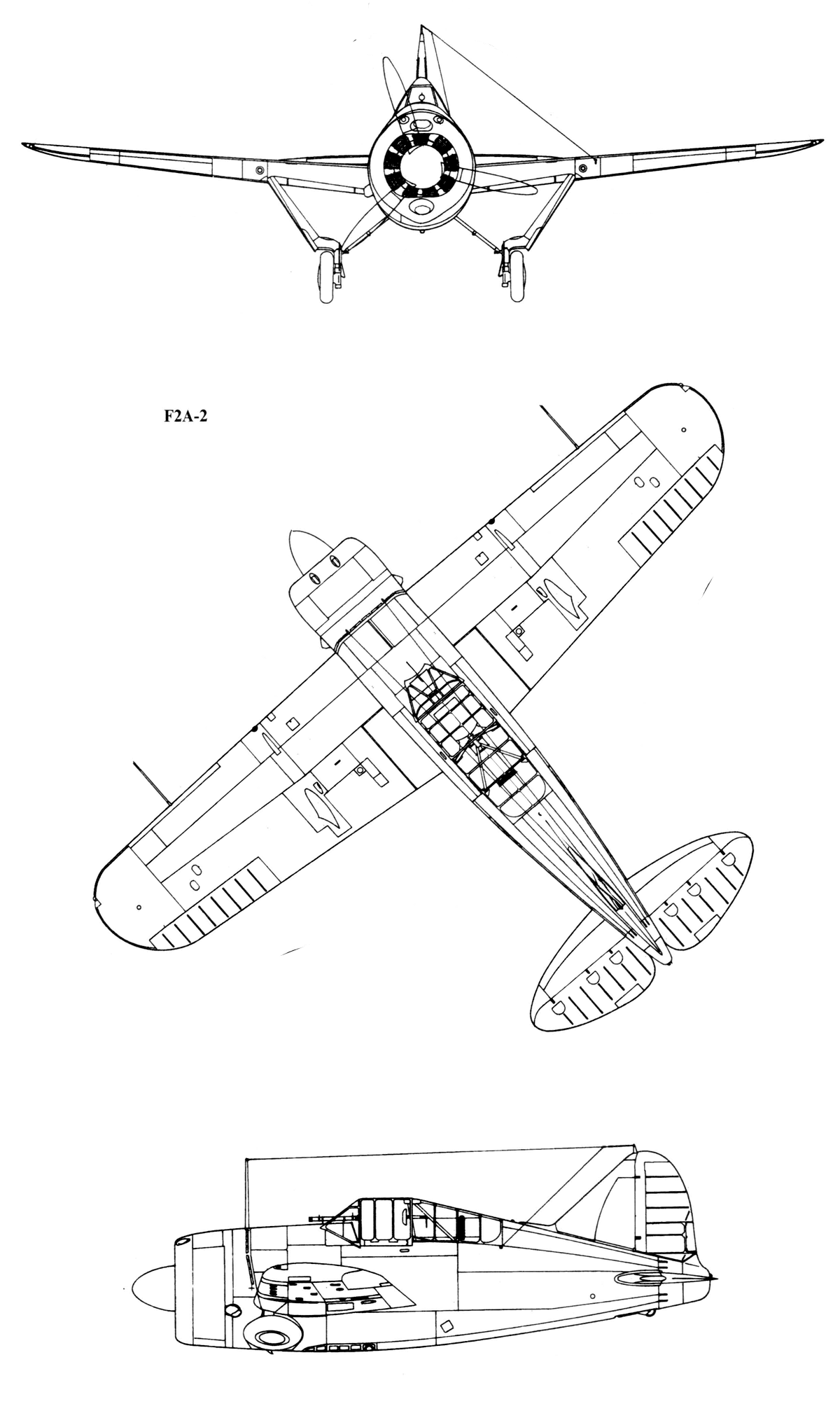
The Brewster F2A had a semi-monocoque fuselage of oval cross-section and very full contours. The wing was single-spar, with a NACA-230 airfoil. The skin was fairly thick throughout—around 1.5-2.5 mm—and functional. The aircraft's structure was all-metal, with the exception of the deflecting surfaces, which had a metal frame covered with fabric. The aircraft was designed to excessive strength standards, reflecting the lack of experience in aircraft strength calculations among the former railroad car builders. This explains the aircraft's heavy construction. Nevertheless, the aircraft was positively buoyant and could float for a relatively long time during an emergency landing. The design made extensive use of round-head rivets to simplify the process.
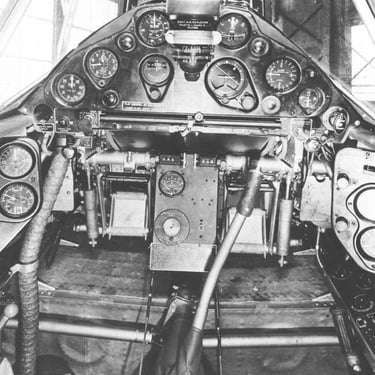
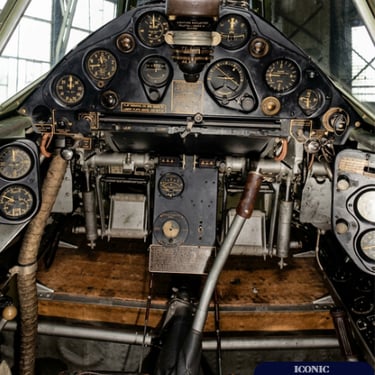
The pilot's cockpit had no floor; the seat was mounted on an armored bulkhead (7.62mm thick). The canopy was sliding and multi-paneled, providing excellent visibility, including to the rear. On aircraft operating over sea, a container containing a rescue inflatable boat was attached behind the armored backrest. The aircraft had a radio in a compartment behind the armored backrest.
The engine was a 9-cylinder air-cooled Wright Cyclone engine, the first model had the XR-1820-G1 (850 hp), and later models had the R-1820-G5 (950 hp) and R-1820-G40 (1,200 hp). The cowling was a NACA type. The propeller was a three-bladed Hamilton Standard Hyde-Romatic variable-pitch design with a diameter of 2.74 m or 3.12 m, or a Curtiss Electric with a diameter of 3.05 m. A fairing was sometimes installed on the propeller hub, completely or partially covering it.
The main fuel tank was located in front of the cockpit and had a capacity of 143 liters. The wing contained compartments that could accommodate two additional 130-liter tanks. All tanks were self-sealing and had an inert gas filling system.
The aircraft's landing gear is a tricycle with a tailwheel. The main landing gear was of an original, not entirely successful design. When extended, the landing gear had a V-shape, with the load distributed roughly equally between the landing gear and the retractable strut. When retracted, the strut was hydraulically retracted into the fuselage, retracting the landing gear into the wing, and the retractable wheel retracted into the fuselage. The main landing gear design was one of the aircraft's weak points. Its strength was clearly underestimated. The tailwheel on early aircraft was non-retractable, self-orienting within 360 degrees, and equipped with a locking system in the neutral position. On the F2A-2 and -3 series aircraft, the tailwheel was made retractable. Carrier-based aircraft had a cast rubber roller on the tailwheel; export models were equipped with a normal wheel instead.
The flaps and landing hook are hydraulically operated. The production aircraft was armed with two synchronized 12.7mm Browning AN-M2 machine guns with 750 rounds per gun. Two more of these machine guns could be installed in the wing with 450 rounds per gun if the fuel tanks were removed. The guns were reloaded pneumatically. Early aircraft had a telescopic sight, while later models had a collimator. The aircraft had no mounts for bombs or drop tanks.
F2A "Buffalo", Brewster Fighter