Blohm und Voss "BV-155", Fighter
Developer: Blohm und Voss
Country: Germany
First flight: 1944
Type: High-altitude fighter-interceptor
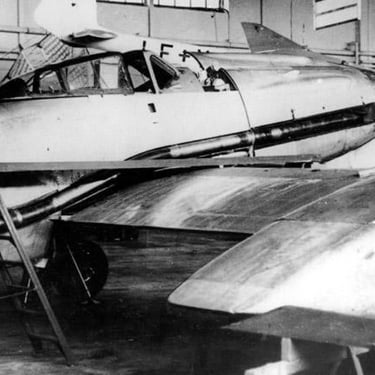
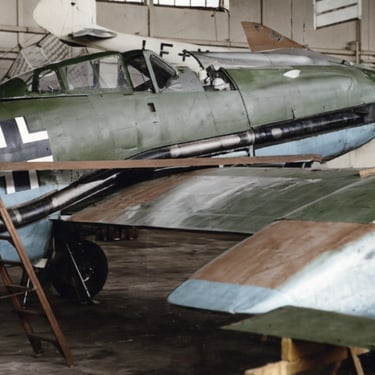
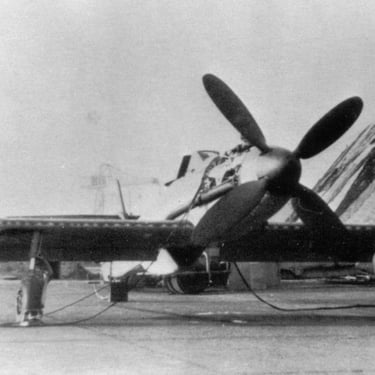
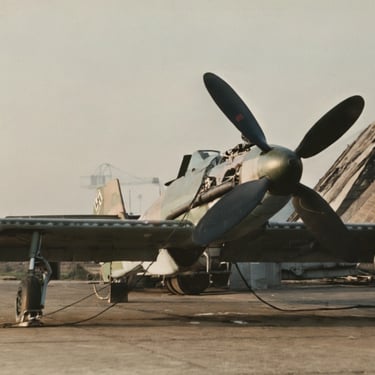
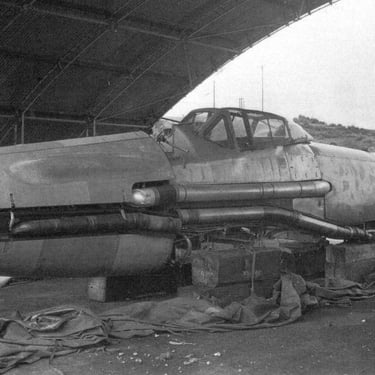
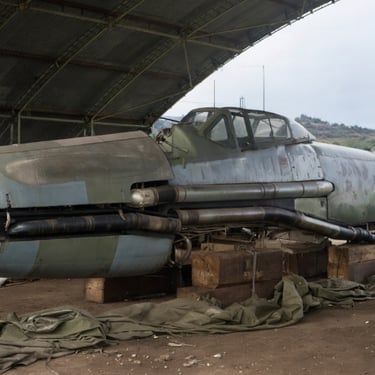
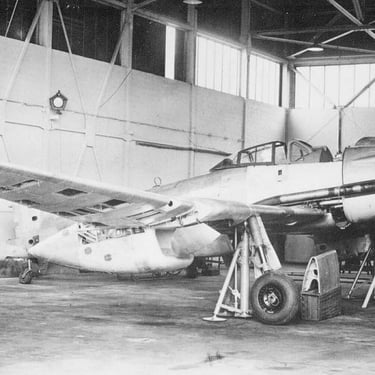
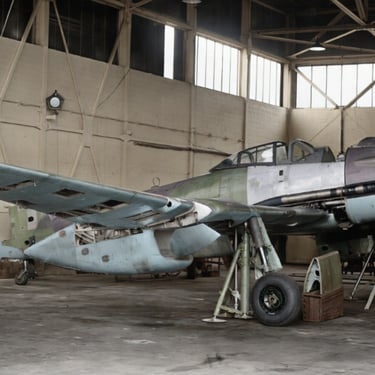
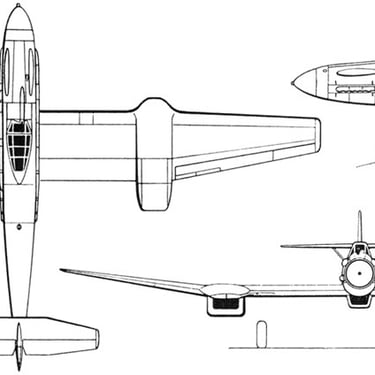
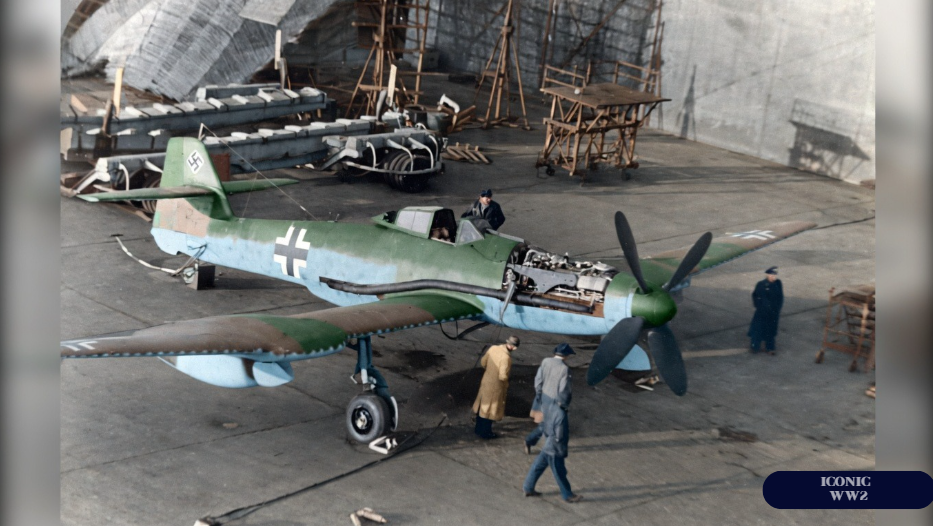
One of the most bizarre piston-engine fighters to emerge in the Third Reich during World War II was the clumsy BV.155 high-altitude interceptor, boasting an exceptionally long wingspan and, on the B-series, a completely unconventional radiator arrangement. The story of its development was no less intriguing than its appearance. For starters, the aircraft originated not in the Vogt design bureau, but in the design department of Waldemar Voigt at Messerschmitt AG in Augsburg. Furthermore, its original design number belonged to a single-seat carrier-based fighter, and was reassigned by the Technical Department to a project for a fighter capable of achieving super-high altitudes at the time.
In the spring of 1942, Grand Admiral Erich Raeder renewed his request for the completion of the aircraft carrier Graf Zeppelin. Work on this ship had ceased in May 1940. She was transferred from Gothenhafen to Stettin, and her fate was unclear. Finally, on May 13, 1942, the naval staff issued an order to continue work on the carrier, which was now to carry 28 bombers and 12 fighters. However, the Bf.109T, originally designed for the carrier, was already obsolete, and Messerschmitt AG prepared a proposal for a new carrier-based fighter, designated the Me.155. By this time, RLM had abandoned the established practice of assigning sequential numbers and reverted to those that were not used (the "155" was originally reserved for Klemm). The Technical Department particularly emphasized the importance of the project and the need to use Bf.109 components for the new aircraft, in order to facilitate production and reduce the burden on Messerschmitt's designers, who were already overwhelmed with work. The response to the request was very prompt, the proposal was accepted by the Technical Department, and by the end of September 1942, the design was completed. The fuselage and empennage were from the Bf.109G, and the DB-605A-1 engine produced 1,475 hp for takeoff. The wing was completely new, with a span of 11 meters and an area of 18.8 square meters.
The landing gear retracted along the wingspan to the aircraft's centerline. Provision was made for folding wings, catapult mounts, and an arresting hook. Armament consisted of a 20mm MG-151 cannon with 220 rounds and two wing-mounted MG-131 machine guns with 250 rounds per gun. Empty weight was 2,900 kg, and cruising weight was 3,530 kg. Maximum speed was estimated at 645 km/h, and endurance at 1.16 hours. By the time the Me.155 design was completed, it was clear that numerous modifications to the Graf Zeppelin would require at least two years of work before the ship was fully operational. Enthusiasm waned, and realizing that the aircraft carrier would not be operational in the near future, Messerschmitt was advised to shelve the Me.155 project. Graf Zeppelin itself was towed to Kiel in early December 1942 to begin work, but by February all work on the ship had ceased.
Blohm und Voss "BV-155", Fighter
Unwilling to abandon the project, in November 1942, Messerschmitt proposed to the Technical Department a new design for a single-seat bomber capable of hitting point targets with a 1,000 kg bomb. The new design eliminated all carrier-based equipment, increased fuel capacity, and lengthened the tail landing gear to allow for a longer takeoff run with the bomb loaded. With a maximum takeoff weight of 4,500 kg, the Me.155A was projected to reach speeds of up to 646 km/h (400 mph) without external hardpoints and 507 km/h (315 mph) at 7,000 m (23,500 ft) with the SC-1000 bomb. By the end of 1942, the Luftwaffe sensed the potential for bombers operating at altitudes inaccessible to existing fighters. Priorities shifted, replacing a bomber with a high-altitude fighter. Since the project was considered so important, Messerschmitt was asked to urgently develop a new specification. Thus, the aircraft was again converted, this time into the Me.155B – an interceptor with a ceiling of 14,100 m. The wingspan was increased to 13 m, a pressurized cabin was installed, and the engine was supposed to be a DB-628 – a DB-605 analogue, but with a two-stage supercharger and intercooler. In May 1943, the Bf.109G was equipped with the DB-628 and underwent two 30-hour test phases, reaching an altitude of 15,500 m. However, the Technical Department decided that the DB-603, with its TKL-15 turbosupercharger powered by the company's exhaust gases, was more promising. Accordingly, the fuselage was lengthened to accommodate it behind the cockpit. The exhaust gases passed through a duct outside the fuselage and turned the drive turbine, which was connected via a fluid coupling to a two-stage centrifugal supercharger. The engine air intake was located under the fuselage behind the wing. Air passed through a turbocharger, then through an intercooler to a supercharger, and then through another intercooler to the engine. The wingspan was again increased, and four radiators were installed under the wings.
In August 1943, the Technical Department concluded that Messerschmitt was already too busy with critical projects to devote sufficient attention to the Me.155B. It was proposed that all drawings and calculations be transferred to Blohm und Voss. By this time, the Me.155B-1 design was completed, featuring the outer wings of the Bf.109G but with a longer-span center section, the stabilizer and landing gear of the Bf.109G, and the vertical stabilizer of the Me.209. The fuselage was based on the Bf.109G with an additional section and engine mount from the Me.209. After a thorough examination of the work, Vogt and his team decided that the design had too many weaknesses to become a viable high-altitude fighter. Friction between Blohm und Voss and Messerschmitt escalated. Meanwhile, RLM issued instructions obligating Blohm und Voss to complete work on the project as quickly as possible, with Vogt required to obtain Messerschmitt's approval for every major design change. Having failed to reach agreement, Vogt wrote to RLM: "After a careful study of the design, we have concluded that a number of aircraft components must be redesigned. The following parts must be completely redesigned: 1) the center section structure; 2) the fuel storage arrangements; 3) the landing gear and its release mechanism; 4) the radiators; 5) the wing profile; 6) the supercharger installation; 7) the horizontal tail." After a series of fruitless meetings, attended by representatives of the Technical Department, who attempted to defuse the situation, RLM rejected Messerschmitt's arguments and placed full responsibility for the development on Blohm und Voss, issuing a contract for three prototype aircraft.
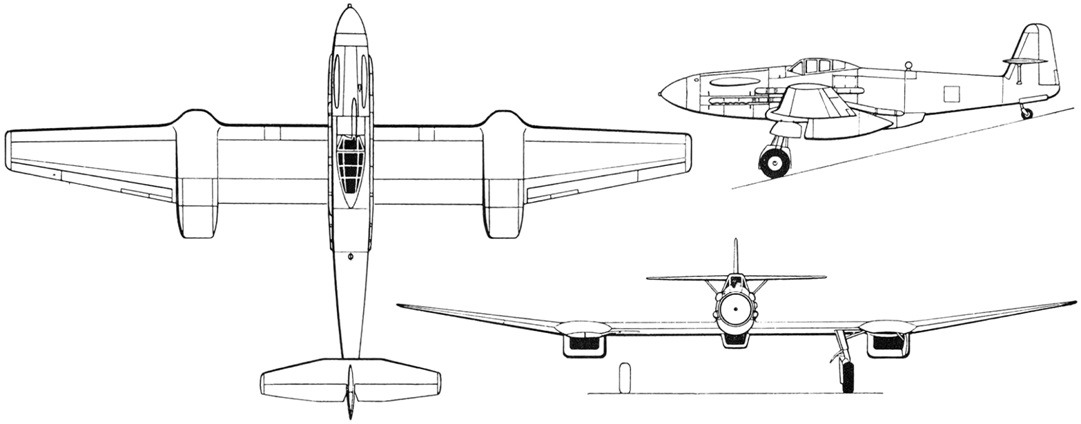
The redesign continued at Finkenwerder until the end of 1943. Vogt chose a laminar flow wing profile for the aircraft and discarded the outer wings from the Bf.109G, declaring that it was simpler to redesign the wing than to integrate a new landing gear and radiator into the Messerschmitt wing. The slats were removed, and the flaps were replaced with ailerons. The center section was completely redesigned; the main spar, 45% of the wing chord wide, housed six individual fuel tanks and was reinforced with a hollow triangular spar made of 5 mm thick welded plate. The tanks held 1,200 liters of fuel and were protected by 8 mm thick armor at the front. Wind tunnel tests showed that two large-section radiators above the ends of the center section were more suitable than four individual radiators under the wings. The landing gear was taken from the Ju.87D-6. The rear fuselage was reinforced, and the stabilizer was replaced with a larger one—from 2.7 to 3.9 square meters. The vertical stabilizer was also enlarged.
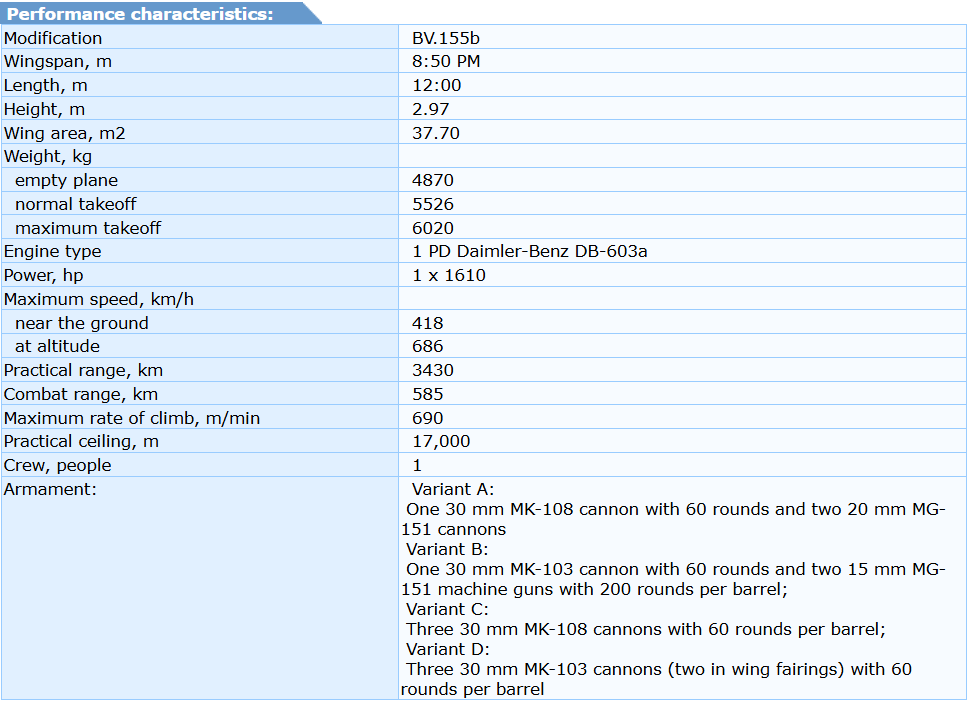
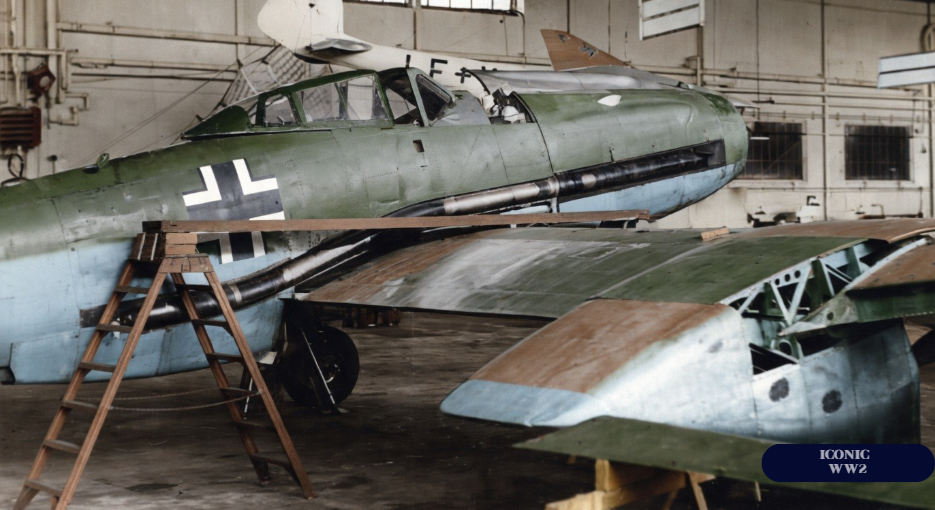
Construction of prototypes began in 1944. The first Me.155-V1 (later renamed the BV.155-V1) flew on September 1, 1944. The engine was a DB-603A with a turbocharger, producing 1,450 hp at an altitude of 15,000 m. The four-bladed wooden propeller had a diameter of 3.9 m. The aircraft was equipped with an MW-50 aftertreatment system, an Rb-50/30 camera behind the pilot's seat, a FuG-16ZY radio set with the ability to determine bearings and distances, and a FuG-25a. The normal fuel capacity was 600 liters, and the full capacity of the spar tank was 1,200 liters. The pressurized cabin was welded from steel sheets, and the engine and turbocharger were attached to it. The canopy was sealed with rubber tubes. The cabin was pressurized by an engine supercharger equipped with a dedicated fan. A pressure equivalent to 7,500 meters (24,500 ft) was maintained up to the flight ceiling. The second prototype, the BV.155-V2, entered testing on February 8, 1945. It incorporated further design changes based on the V1's testing results. The central and tail sections of the fuselage, as well as the empennage, were modified. Since each V1 takeoff was accompanied by a dangerous temperature rise, the V2's radiators were mounted on the wing, with a higher angle of attack. Furthermore, it was clear that the radiator surface area needed to be increased. The wing-mounted radiator was chosen due to concerns about airflow obstruction by the landing gear during the most critical phase of takeoff. However, wind tunnel tests showed that with the main piston of the landing gear retraction system removed, a radiator stall was not dangerous.
As a result, the V2's radiators were mounted under the wing, but this required moving the cockpit forward to maintain the center of gravity. Having made the necessary modifications, Vogt also decided to use a sliding canopy with good visibility. To achieve this, the rear fuselage was cut away and the vertical stabilizer was extended. This necessitated redesigning the rudder and stabilizer. Its span was increased from 4.2 to 5 meters by inserting a straight section. The radiators were also slightly modified, being further lowered. All these changes were incorporated into the V2, which was considered the prototype for the B-series, but Vogt and his team were not satisfied with the aircraft. Its design suffered from a number of inevitable flaws. Further modifications were required to eliminate all the inaccuracies of the basic configuration. Thus, even before testing of the BV.155-V2 began, Blohm und Voss proposed a revised version – "Project 205" – to the Technical Department. A DB-603U engine, equipped with a DB-603E supercharger and a 2.07:1 reduction gear, was proposed. The TKL-15 turbocharger remained. Given the dire situation facing the Third Reich, it was somewhat surprising that the Technical Department accepted the proposal to discontinue development of the BV.155B in favor of a new variant, the BV.155C. A series of 30 aircraft was ordered. Shortly after testing began, the BV.155-V2 made an emergency landing in swampy terrain. The aircraft sustained only minor damage during landing, but excessive infantry efforts to tow the aircraft by chains from an armored personnel carrier by the wings resulted in irreparable damage. Assembly of the last B-series aircraft, the BV.155-V3, proceeded in Finkenwerder in parallel with the development of the BV.155C design and the preparation of a pre-production batch. The V3 differed from its predecessor only in the installation of the engine planned for the C-series. The engine cowling and TKL-15 turbocharger remained unchanged. Externally, the BV.155C was less bizarre than the BV.155B due to the elimination of the clumsy wing radiators. The wing structure remained unchanged. The outer wings were simply attached to the center section, rather than a complex framework passing through the radiator. The wing area was somewhat reduced, but the loss of lift was partially offset by an extension of the forward wing fairing. The removal of the wing radiators, which served as retractable landing gear bays, necessitated a retraction pattern that was now closer to the aircraft's centerline. The landing gear legs were shifted inward. The wheelbase was shortened from 6.7 to 3.9 meters. A more compact liquid cooling system was introduced, modeled on the Ta.152 radiator. Two large air intakes were mounted behind the trailing edge of the wing. The right air intake was for the turbocharger, while the left one fed air to the heat exchanger, which then exited through a slot behind the right air intake. After the compressor, the air passed through a cooler in the lower radiator and through an induction manifold. The cockpit and fuselage remained virtually unchanged.as was the horizontal tail, although the stabilizer struts were removed. The vertical stabilizer was enlarged and redesigned.
The production plan called for the BV.155C-01 (V4) to be ready in April 1945, the C-02 in May, and the C-03 and -04 in June. However, assembly was still unfinished by the time the Finkenwerder plant was captured by the Allies. The unfinished third prototype was subsequently shipped to the UK, from where, after an exhibition at Farnborough, it was transported to the United States for detailed study.